A RETROSPECTIVE OF UDOMSAK KRISANAMIS: Udomsak Krisanamis
Past exhibition
Overview
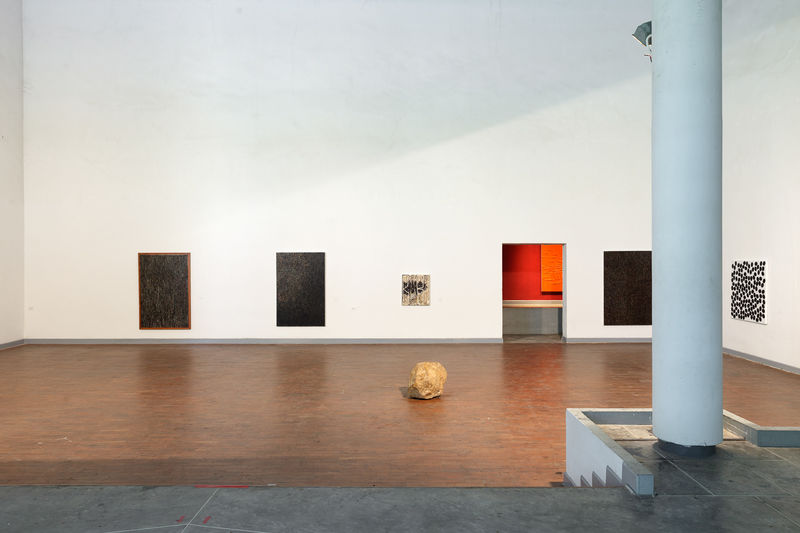
From the very beginning Udomsak Krisanamis saw in his art a struggle of culture and identity, a conflict inflicted upon us from back in the day - when one stood back to make sense of the condition we are in. He saw in his work the question of existence.
In Udomsak’s search for meaning he went looking for what was at the core of its being, in our (his and mine) common language of practice - an embrace of Buddhism from a philosophical rather than religious standpoint. The core being in the center of what is whole. Wholeness is what we seek. and attempt to achieve. Wholeness perhaps, is the way to reach the plateau of no return, the plateau of nothingness.
Nothingness in the west, is often a synonym for the idea of abstraction, the unknown, un-language, and the quality of dealing with ideas rather than events, and/or freedom from representational qualities in art. Perhaps we could add, the freedom from the representational in order to think. The freedom from representation in order to think one’s own ideas.
Can we look into the darkness, into the infinity of the universe and understand from where do we come? In order to understand why we are here and where we are going? Can language be formulated to give us answers to the questions of our existence or a picture capable of giving us the experience of the unknown, a picture in our mind of a place that we do not yet know exists? The image of Buddha is an image of everyman (human) and no man (human). It is a representation of an idea, it is a representation of abstraction.
However we see it (as it is an it), we conjure from our selves the understanding of the idea. We bring our experience, our knowledge, our ignorance to formulate meaning. We use the image of (un) representation, to make meaning, to make beliefs, to make a value we do not fully understand. We think we know what it means to believe, we think we know the language, the philosophy the teachings, the path, the road, the way to the wholeness which will set us free. We never ask what it means, we never doubt the existence of the idea. We never doubt the reasons we follow the path to nirvana, the place of no return, the place of nothingness.
Yet here we stand as a viewer, as an audience, with our own eyes as witness to the work of Udomsak Krisanamis. His years of work and toil, a dialogue with the self, which in turn has become a dialogue with the world, with society, with language, with belief, with doubts, with success and with failure.
One man’s attempt to communicate the un-communicable, to rethink the dominance of one word over another, one gesture against another, left hand verses right, mindlessness over mindfulness, democracy over tyranny, conflicts we have within ourselves that form and inform us.
A life’s work never ends, it may even continue after life. Here Udomsak lays bare the ground on which he has chosen to walk, a path he saw fit to follow. He refuses to speak, to make noise, to make explanations, which make understanding or clarity difficult. That resistance has been a strategy against certain forms (western vs. eastern) of the formation of knowledge and certain forms of language. It is language that Udomsak negates in his action, in the translation of his mind to his hand, the language he has time and again attempted to reduce to the essence, to the core, to find himself and his wholeness.
All the paintings in this exhibition have been re-constituted, reformed by the hands of many people. This retrospective is in itself an attempt to bring into matter ideas of representation and language, and in turn, to become experience. The paintings we see here are an attempt to recollect, recall, and remake images that already exist in time and space. Just as words are used over and over again in different contexts and conditions, giving us, through their repeated usage, other meanings.
We understand because we use it, we come to an understanding through usage, and here Udomsak is reuses his own work, and makes for us the tool to understand, to think and to contemplate, to experience. A tool for you and I, the viewer, the audience, the passerby – to stop, and pay attention.
The works here are to be taken in as a whole. This exhibition is not about the singularity or value of a well- crafted hand, or of time well spent. It is the whole, a life lived close up and low down to the ground we all walk on and exist in. It is spent on the everyday, it is touched by everything, and it is a mark of its time.
- Rirkrit Tiravanija, June 2016
- Rirkrit Tiravanija, June 2016
We would like to acknowledge the artist Udomsak Krisanamis who made the original work that is copied here for the retrospective re-presentation, and the young artists whose time and craft made the exhibition possible:
Anurak Tanyapalit.
Chayanee Wongsitthiphaithoon Chayawat Panyaphet
Jettana Savangnam
Jutamas Rattikanok
Julaluck Santisiri
Jood jung
Nattawut Tatiwetchakun
Nida Chimdet
Patchara Nantana
Panida Kernjinda
Paphonsak La-or Rawiwong Thongin Surajate Tongchua Thitiphorn Kotham Udit Juntima Yuwatee Jehko Ubatsat
Installation Views


